
Peace is Impossible While States Exist.

The belief that governments originally emerged from some sort of social contract is surprisingly widespread. Sure, very few people believe there was an actual moment when everyone suddenly decided to make states in exchange for safety, but an at-least-implied agreement is assumed to lie behind the continued legitimacy of nation-states.
For instance, The Shriver Center on Poverty Law, under the headline “Trump and Congress rewrite the social contract,” claims that Trump’s 2025 “Big, Beautiful Bill”: “rewrites the social contract as we know it by transferring trillions of dollars upwards to the wealthiest Americans at the expense of low-income and working people.”[1] A few months earlier, The Roosevelt Institute published “Social Security Cuts Betray the Social Contract,” making a similar claim about recent innovations in trickle-up economics and the social contract.[2] Meanwhile, Trump’s Treasury Department put out a press release about “Trump Accounts.” These would “return us to a social contract anchored in individual ownership.”[3]
Many people assume that social contracts legitimize our governments. We can break or maintain these contracts. But they exist, and are the basis of how and why we interact.
There are good reasons to doubt social contract theory. Way back in the eighteenth century, David Hume pointed out that “almost all the governments, which exist at present, or of which there remains any record in story, have been founded originally, either on usurpation or conquest.”[4] Following Hume’s logic, governments were little more than protection rackets that gained legitimacy through ubiquity.
That’s not the only problem. Social contract theorists inevitably imagine isolated individuals coming together to make a pact to meet their collective needs. But humans are social beings. We have always exercised collective power to get things done. States and hierarchical institutions are unnecessary additions to already existing systems for cooperating. The whole theory is based on modern rights-based individualism that is then projected onto earlier eras before these ideas were commonplace.
But even if we accept social contract theory as an accurate account of why and how we made nation-states, the states they describe cannot guarantee peace or safety. In fact, peace is impossible while states so conceived continue to exist.
States of Nature
We’ll take Hobbes, Locke, and Rousseau as the paradigmatic social contract theorists. They all agree that humans were once in a “state of nature” but found it necessary to contract governments into existence. The reasons vary. Hobbes argues that in the state of nature, “notions of right and wrong, justice and injustice, have there no place.”[5] Without legal impediments, everything is permitted and no one is safe. And so, everyone chooses to leave the state of nature and make a covenant with one another to have a sovereign—whether king or committee—whom they will all obey.
Locke rejects Hobbes’ amoral state of nature and insists that there is a natural law that gives moral guidelines in advance of sovereign authority. We can all use reason to apprehend natural law and understand how to treat each other, with or without governments. But Locke’s state of nature still devolves into a Hobbesian war of all against all, and everyone gets together to make a contract.
Rousseau imagines humans in the state of nature living solitary lives with very few needs. It was pretty peaceful. Then people came up with metallurgy and agriculture, and that simple life was destroyed. “As soon as men were needed to smelt and forge iron, others were needed to feed them.”[6] Cultivating land led to dividing land being, which led to property laws, inequality, and subjugation. This devolved into a Hobbesian war of all against all, and everyone got together to make a contract.
There was almost certainly never a moment when people came together to make governments from scratch. In that sense, social contract theory is completely fictional. But it seems like many of us accept an at least imagined covenant as the basis of government. In that sense, we have made the social contract real, thereby turning a thought experiment into common sense. Consider the quotes at the beginning of this. Even if there never was a contract, enough people act and talk like there was one that it has become a form of reality.
States Can’t Make Us Safe
Looking back at the big names in social contract theory, they all agree that humans wanted a contract for safety and protection. But if we look back even more carefully, we realize that the states they imagine can’t make us safe.
Even after the social contract, the various sovereign powers remain in a state of nature with one another. For instance, Locke describes people in his state of nature as “all being kings.”[7] Most of us stop being kings after the imaginary ink on the imaginary contract dries, but “all Princes and Rulers of Independent Governments all through the World, are in a State of Nature.”[8]
Hobbes similarly says that “In all times, kings and persons of sovereign authority” maintain “a posture of war.”[9]
Rousseau agrees with Locke and Hobbes, but also explains how dangerous this is. “As individuals, we live in the civil state, under the control of the Law; as nations, each is in the state of nature. And it is this which makes our position worse than if such distinctions were unknown. For, living as we do at once in the civil order and in the state of nature, we find ourselves exposed to the evils of both conditions, without winning the security we need in either.”[10]
Because governments are composed of people, when nations treat each other like individuals in a state of nature, it’s the people composing the nations who do the dying.
Even when we look at social contract theory in the best possible light, it seems like all nation-states really manage to do is pull us out of an imagined state of nature between one another and into a real state of nature between nation-states where the possible levels of death and destruction are incomprehensibly worse.
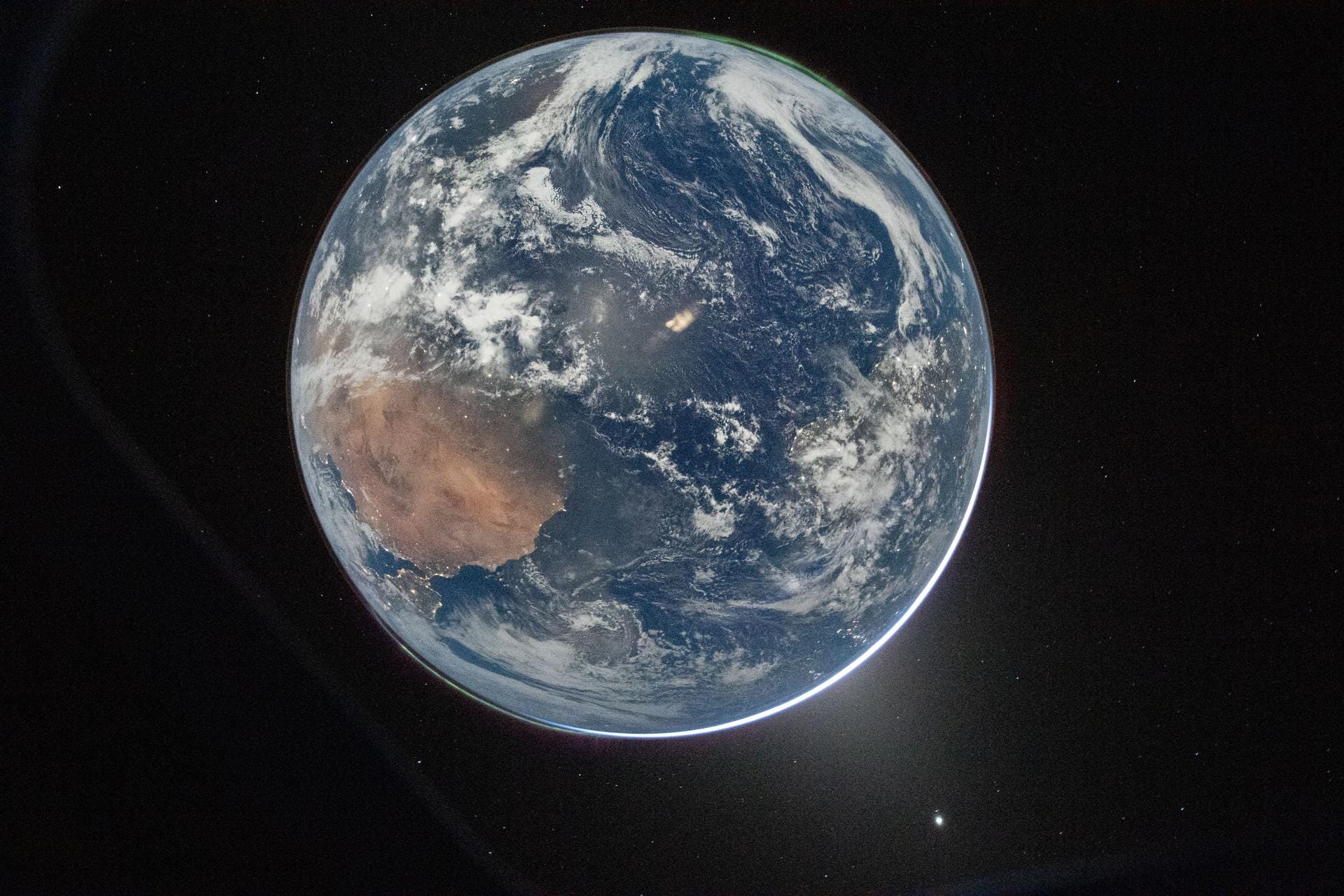
A small group of astronauts with a malfunctioning toilet recently flew around the moon and back. They sent back photographs of Earth from space. From that distance, we just see land masses with no discernible borders. Here on the ground, fences, signs, and people demanding our passports delineate abstractions we call “nations” that coexist in a Hobbesian state of nature.
Right now, citizens of Gaza, Iran, Sudan, Lebanon, and numerous other places may live among fellow citizens with whom they have juridical relations. But if world leaders remain in Hobbesian relations with other world leaders, those juridical relations do them little good, and they might suffer a violent death at any moment and that’s just a consequence of states being states.
The modern nation-state is a bad idea, in several senses of “being a bad idea.” Social contract theory may be a fiction, but it’s a fiction many people believe. And by believing it, we keep ourselves in a very dangerous situation where we see that dangerous situation as rooted in a real agreement. Don’t be fooled. The state is not your friend.
[1] “Trump and Congress rewrite the social contract,” www.povertylaw.org, July 11, 2025.
[2] “Social Security Cuts Betray the Social Contract,” www.rooseveltinstitute.org, March 28, 2025.
[3] “Trump Accounts, The Defining Policy of America’s 250th Anniversary,” U.S. Department of the Treasury, January 28, 2026.
[4] David Hume, Political Writings (Indianapolis: Hackett Publishing, 1994), 168.
[5] Thomas Hobbes, Leviathan (1651: Oxford: Oxford World Classics, 1996), 85, Head Edition 63.
[6] The Discourses and Other Early Political Writings (Cambridge: Cambridge University Press, 2019), 173.
[7] John Locke, Two Treatises of Government (Cambridge: Cambridge University Press, 1988), paragraph 123, p. 350.
[8] Ibid., paragraph 14, p. 176.
[9] Hobbes, Leviathan, 85, Head 63.
[10] Jean Jacques Rousseau, A Lasting Peace Through the Federation of Europe and The State of War, (London: Constable and Company, 1917), 127. Emphasis mine.