
Lessons for the Present Found Through Nineteenth Century Readings of Ancient Authors

In Twilight of the Idols, Friedrich Nietzsche writes, “my cure from all Platonism has always been Thucydides.”[1]
Who is Thucydides? Thucydides was a historian and general who fought for Athens in the Peloponnesian War and then wrote a history of that long conflict between Sparta and Athens.
But how is a historian a cure for Platonism, and why does Platonism even require a cure?
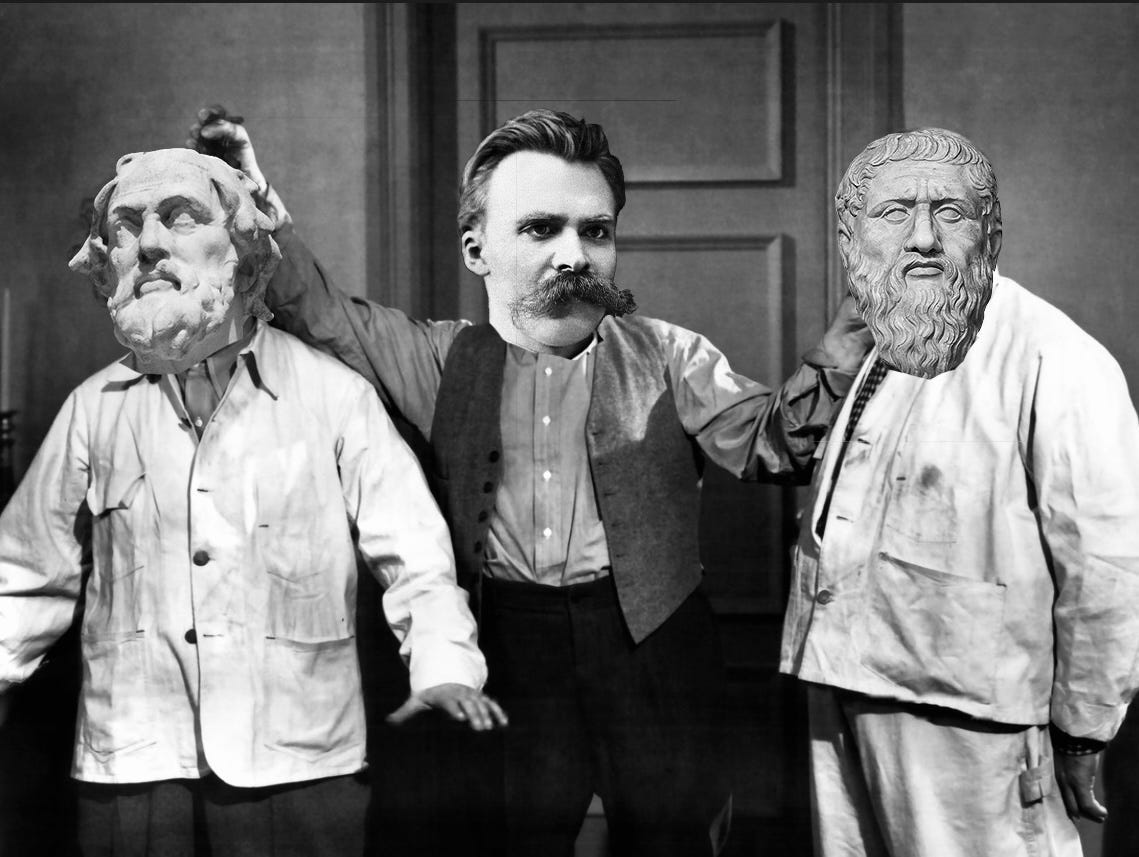
For Nietzsche, “Plato is a coward in face of reality—consequently he flees into the ideal.”[2] But Thucydides, along with Machiavelli, “are related to me closely by their unconditional will not to deceive themselves and not to see reason in reality.”[3]
In the Laws and the Republic, Plato tries to lay out the ideal society or system of laws that would serve the “good.” The laws and social structures are discovered in advance of the city, and the idea of life precedes the living of it. This is a typical line of thought for Plato. There’s an ideal toward which reality aspires but inevitably falls short.
Plato wants to uncover reason in reality. For Nietzsche, this is a mistake. Plato puts “the ‘highest concepts,’ that is to say the most general, the emptiest concepts, the last fumes of evaporating reality, at the beginning as the beginning.”[4]
He sees Thucydides as grounded in unevaporated reality. His history of the Peloponnesian War is filled with speeches from various participants in the war, allowing Thucydides to use their mouths to expound eloquently on political and military theory. But their eloquence is almost inevitably followed by ruthless and destructive violence.
Pericles, who was Athens’ leading figure in the early years of the war, delivers a funeral oration in honor of the war dead. He talks about what they’re fighting for. “Let me say that our system of government does not copy the institutions of our neighbors. It is more the case of our being a model to others, than imitating anyone else. Our constitution is called a democracy because power is in the hands not of a minority but of the whole people.”[5] Of the two great powers in Greece at the time, the Athenian way of life was the one worth fighting and dying for, and Pericles wanted them to know it. “This, then, is the kind of city for which these men, who could not bear the thought of losing her, nobly fought and nobly died. It is only natural that every one of us who survive them should be willing to undergo hardships in her service.”[6]
Later in the war, the island of Melos allied with Sparta. They had been neutral, but when “the Athenians had brought force to bear on them by laying waste to their land, they had become open enemies of Athens.”[7] In other words, Athens attacked a neutral party and they stopped being neutral. So Athens showed up with their navy and gave Melos the choice between subjugation and destruction. The Athenians let them know, “It is not so much your hostility that injures us; it is rather the case that, if we were on friendly terms with you, our subjects would regard that as a sign of weakness in us.”[8] For the sake of their empire, they need to look tough. The Athenians besieged Melos, conquered them, and then “put to death all the men of military age whom they took, and sold the women and children as slaves.”[9] Athens might declare their empire “good” and worth fighting for, but the cruel logic of empire inevitably destroys innocent lives for reasons of state.
Thucydides pulls our attention away from any idealized good and shows us power acting solely in the interest of power. This is how Thucydides cures Platonism.
Nietzsche is by no means an anarchist, but passages like the one we’ve been examining may be why an anarchist like Emma Goldman admired him. Once you decipher why Thucydides is Nietzsche’s cure for Platonism, you can only conclude that the state is not your friend.
[1] Friedrich Nietzsche, Twilight of the Idols and The Anti-Christ (1889: New York: Penguin Books, 2003), 117.
[2] Ibid., 118.
[3] Ibid.
[4] Ibid., 47.
[5] Thucydides, History of the Peloponnesian War (New York: Penguin Books, 1972), 145.
[6] Ibid., 148.
[7] Ibid., 400.
[8] Ibid., 402.
[9] Ibid., 408.