
From Grid to Grind:
Part I, The Grid

From airplane windows, we see that much of the United States is composed of right angles and rectangles. Patches of fields, roads, cities, and fences create endless checkerboards in every direction. But land doesn’t just come like that. Someone clearly planned this.
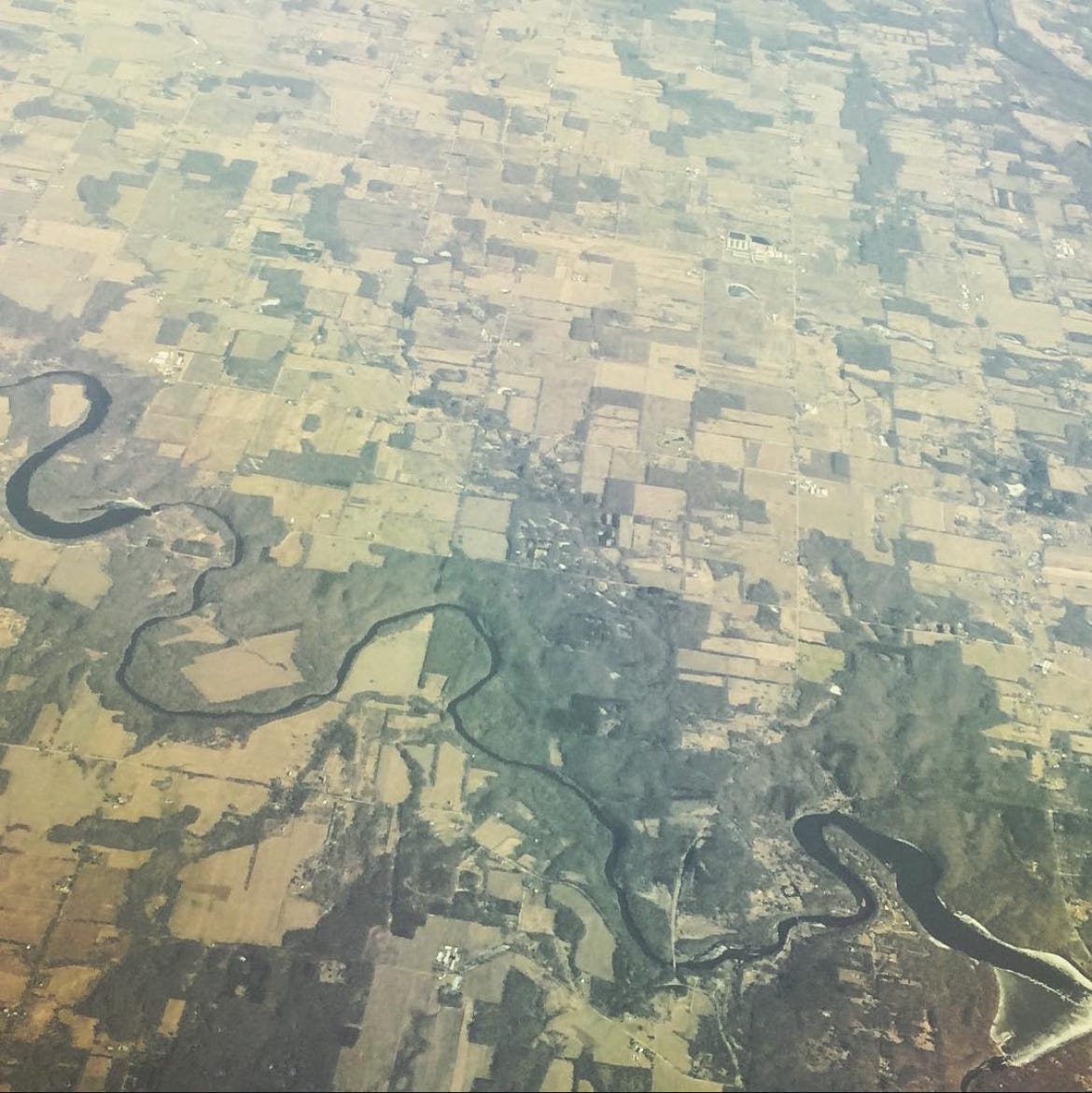
Why do Americans live inside a grid, and what has it done to them?
The reasons for this grid go back more than two centuries. About two hundred and fifty years ago, a portion of the British citizens living in North America got so mad about paying their taxes that they waged a war for independence and won. (The British declared the Colony of Massachusetts in rebellion in February of 1775 and the battle of Lexington and Concord occurred in April of that same year, so in 2026, when people are celebrating 250 years of the USA, please remind them that the nation’s 250th birthday was last year, and any real patriot would know that.) After their successful revolution, these suddenly former subjects of the British Crown faced many daunting challenges. One of the biggest challenges was that wars are expensive, so paying back war debts in a country dedicated to the proposition that high taxes are grounds for revolution was going to be tricky.
One way out of bankruptcy involved selling western lands to farmers. Most of this land was inhabited by indigenous people and had never been surveyed. Future president Thomas Jefferson chaired a committee tasked with figuring out how to divide and sell all that acreage. They came up with six-mile square townships divided into thirty-six lots of 640 acres, aligned along latitude and longitude—even though longitude converges at the poles, making this grid geographically irregular.[1]
This bureaucratic landscaping enacted by lawyers in love with the Enlightenment was a bad way to build a nation. A Cartesian plane, plastered across the plains, demands Americans move within and through its logic. It did not have to be like this. There are other ways.
In the 1970s, Bill Mollison and David Holmgren developed permaculture, a design system that advocates mimicking flourishing ecosystems to create an ecologically regenerative society. The first of permaculture’s twelve principles is “observe and interact.” The natural world does not repeat itself in regular grids. Every chunk of Earth, at any scale, is unique. And that ever-changing landscape will dictate how we interact with it. Where does water drain? Which side of this hill receives the most sunlight? What type of soil is this? What wild animals come here and for what purpose? The questions are endless when we observe and interact.
Sending surveyors to force a grid onto whatever they encounter is not a great way to relate to the natural world. But that is exactly what the U.S. Government did almost as soon as it existed. Rigid right angles have shaped American interactions with a fluid planet, and the repercussions continue into the present.
We are inevitably shaped by the landscapes we create. Thomas Jefferson chaired a committee that laid a grid across the United States and the nation was made to conform to it. The ways one can move through and interact with the land is largely determined by those shapes and lines. Movements and interactions within and through the grid shape the people inside it, who then further warp the world to fit their increasingly grid-shaped lives.
To “observe and interact” requires slowing down and trying to understand a place and how to inhabit it. The modern market economy cannot accept such slowness. A grid provides straight lines, the shortest distance between two places. We annihilate time as we ignore space in in our quest to get somewhere else. But that somewhere else is often nowhere at all. Just more of the grid we pass through on our way to someplace else.
[1] John R Stilgoe, Common Landscape of America, 1580 to 1845 (New Haven: Yale University Press, 1982), 103.