
Be Like Bluto.
Or why all the white guys need their acoustic guitar privileges revoked.

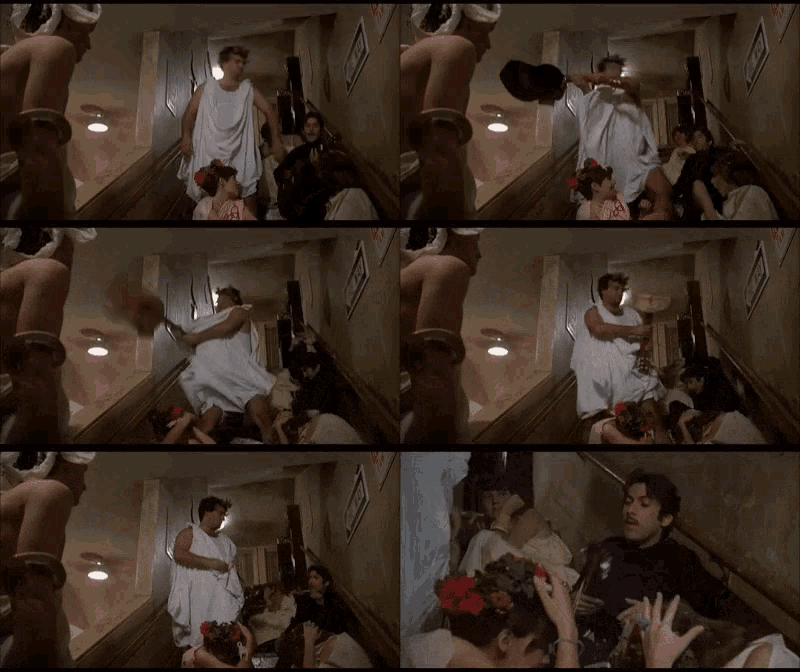
In the 1978 film Animal House, the Delta Fraternity throws a toga party. At the party, a man with an acoustic guitar sits on the stairs, strumming and singing for three women. John Belushi’s character, John “Bluto” Blutarsky, walks past, makes a face as if he’s just stepped onto a fart-filled elevator, takes the guitar from the man, and then smashes it against the wall.
It was my understanding that in that moment, we all collectively decided that we would no longer tolerate men strumming acoustic guitars and singing. Sadly, I was wrong. They are still at it. Strumming. Singing. Just daring me to put on a toga and put a stop to their shenanigans.
A lot of digital ink has spilled lately about David Rovics. A good summary is here. One of his several defenses are probably also worth reading. The short version is that Mr. Rovics has written and performed politically leftist acoustic guitar music and appeared at rallies, protests, and fundraisers for decades. He has also platformed holocaust deniers on his podcast, frequently recommended Gilad Atzmon’s antisemitic book The Wandering Who, and lobbed softball interview questions at Unite the Right organizer Matthew Heimbach. Since the documentation of this grew, Rovic has been literally cancelled from performances, and then started complaining about cancel culture. That’s a summary. I don’t really move in these circles enough to bring this to some sort of conclusion and tell you how I think you should feel about it. I’m solidly against antisemitism, but I actually have a different complaint about Rovics.
I’d like to return to John Belushi smashing that guitar and how unfortunate it is that we did not take that scene from Animal House as the important wake-up call it was. If we had, we probably wouldn’t be dealing with this. When all this news around Rovics started hitting my listservs and social media feeds, my first thought wasn’t “Is he being treated unfairly or is this actually deserved?” Rather, it was “Why are we still having the same sort of music at protests in 2022 as we had in 1915?” I immediately felt like Andy Rooney or something: ranting and out of touch and annoyed about something that doesn’t seem all that annoying. I recognize that. Yet everyone who sings and plays at protests almost invariably channels Joe Hill or a young Bob Dylan—strumming cowboy chords and telling tales of bad bosses and the people uniting. When Tom Morello showed up in Madison, Wisconsin to join the protest against Scott Walker’s union-busting bill, he brought an acoustic guitar and covered Woody Guthrie and Bob Marley. Everyone just instinctively knows their set list even if they made their name making weird noises through effect pedals.
But there’s something below my surface level annoyance that gets at the practice of protest and why singing the same types of songs in the same ways is more than just tiresome, but part of a whole set of counterproductive practices. Acoustic protest music is part of the pageantry of public dissent that makes so many gatherings a predictable sequence of events we can easily enact and the state can just as easily ignore.
Marx opens The Eighteenth Brumaire of Louis Bonaparte with the bulk of his most famous quotations. I’m not sure if he planned that, but such is life. The first paragraph contains the line “the first time as tragedy, the second time as farce.” The second paragraph starts with, “Men make their own history, but they do not make it as they please.” Then it gets slightly less constantly quoted, but still fairly regularly excerpted. “The tradition of all dead generations weighs like a nightmare on the brains of the living. And just as they seem to be occupied with revolutionizing themselves and things, creating something that did not exist before, precisely in such epochs of revolutionary crisis they anxiously conjure up the spirits of the past to their service, borrowing from them names, battle slogans, and costumes in order to present this new scene in world history in time-honored disguise and borrowed language.”
He points out that Martin Luther looked back to the Apostle Paul as a model, while the French Revolutionists looked back to the Roman Republic. Following Marx, the Bolsheviks constantly measured their Russian Revolution against the earlier French one, arguing about whether they’d passed their Thermidorian moment or not—in reference to the coup that got Robespierre’s head detached—or fearing a Brumaire, when a Napoleon might seize power. That time it was a tragedy, with his nephew it was a farce, but if it happened a third time, who even knows how tragically farcical it might get?
We operate in paradigms we know. This certainly helps us make sense of the tumult of living our lives with no idea of what happens next, but it also gets us stuck in patterns. Protests now often involve Gandhian civil disobedience—frequently enacted in cooperation with the police, who are warned about how many people have volunteered for a symbolic arrest so they know how many vehicles to bring to haul them all away. Meanwhile, RevComs hand out literature, and because Bob Dylan opened for Martin Luther King Jr.’s “I Have a Dream” speech, we had better find a folk singer. It’s a set of motions we feel the urge to follow. The tradition of all dead generations weighs like a nightmare on the brains of the living.
Sure, “[We] make [our] own history, but [we] do not make it as [we] please.” We can only work with what we’ve been given through methods we know. But we should focus more on that first part about making our own history. Leave what’s dead in the soil and grow something new with it. We inherit materials and practices, but our focus should be on reimagining them rather than just inheriting them. (The irony of how I structured this section about moving away from old ideas and practices around Karl Marx quotes—a guy who died in 1883—is not lost on me.)
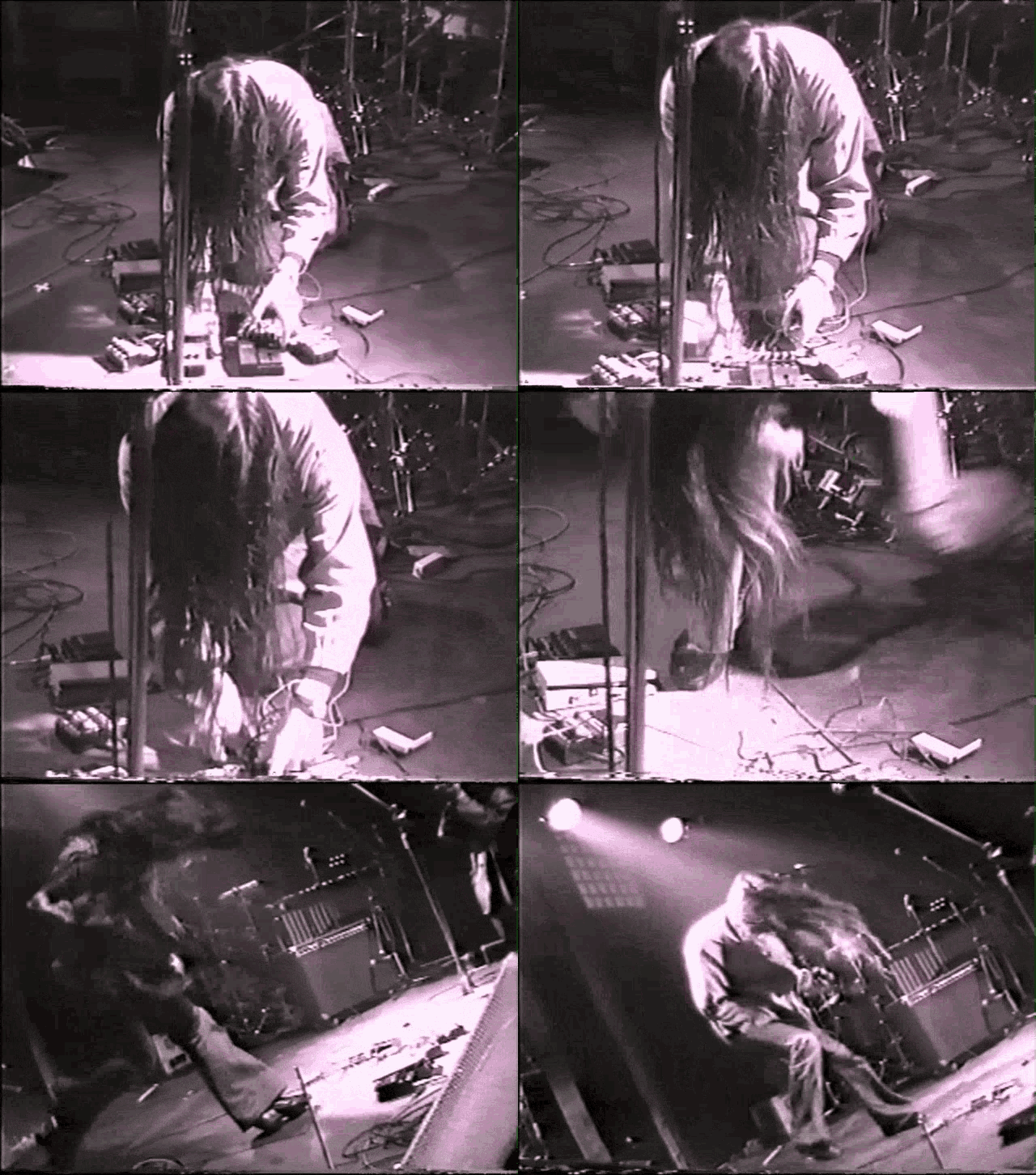
I have long held, to the annoyance of many, that the social relationships embedded in how we present art and music are more politically important than what that art or music is ostensibly “about.” I’ve learned more about how to live as a political animal at noise shows with a potluck dinner where the only discernible lyrics are indiscernible screams than I have listening to some dude sing about the Spanish Civil War while I wait for a march to start. A performance or a gallery show is a social event. How are people meant to navigate it? Do they navigate it as equals? How much agency do we give each other? What can we learn and teach by presenting work in experientially instructive ways?
In my book Art as Politics I quoted John Cage as saying:
I think one of the things that distinguishes music from the other arts is that music often requires other people. The performance of a piece of music is a public occasion or a social occasion. This brings it about that the performance of a piece of music can be a metaphor of society, of how we want society to be. Though we are not now living in a society which we consider good, we could make a piece of music in which we would be willing to live.
Later on, in prose it pains me to paste, I wrote,
Cage’s music has none of the sloganeering or heavy-handed didacticism one might expect from politically-motivated art. He does not offer music arguing for a political message to be accepted or rejected, but rather offers alternate modes of human interaction existing in actual space and time. He thus attempts to create an oasis in the midst of consumer-driven capitalist society, presenting a society governed by a set of rules entirely different from the dominant culture’s. As he noted in a 1991 interview, “If we can have a group in which the individuals are autonomous, then we have a model for society which is free of the need for government, and which could enjoy life.”
Politics is about relationships and how we live our lives. So are art and music. But this doesn’t mean we can exchange them for each other. Each realm involves different sets of practices. There’s a famous quote about how writing about music is like dancing about architecture. (Laurie Anderson, Steve Martin, Frank Zappa, Martin Mull, Elvis Costello, Thelonius Monk, Clara Schumann, Miles Davis, George Carlin and several others have received credit for it.) Different disciplines have different functions. Music can be political, but it does that best when it’s primarily operating as music, rather than as an auxiliary element of a political action. Squished into protests, music in particular becomes part of a predictable pageant that keeps us repeating patterns from the past—this is especially true when it’s the same type of music performed in the same ways. It’s the tradition of all dead generations weighing like a nightmare on the brains of the living, and why, when I heard about the controversy around David Rovics, all I could think about was John Belushi.